
When Automation Is Not the Answer: Recognizing Processes That Should Stay Manual
November 3, 2026
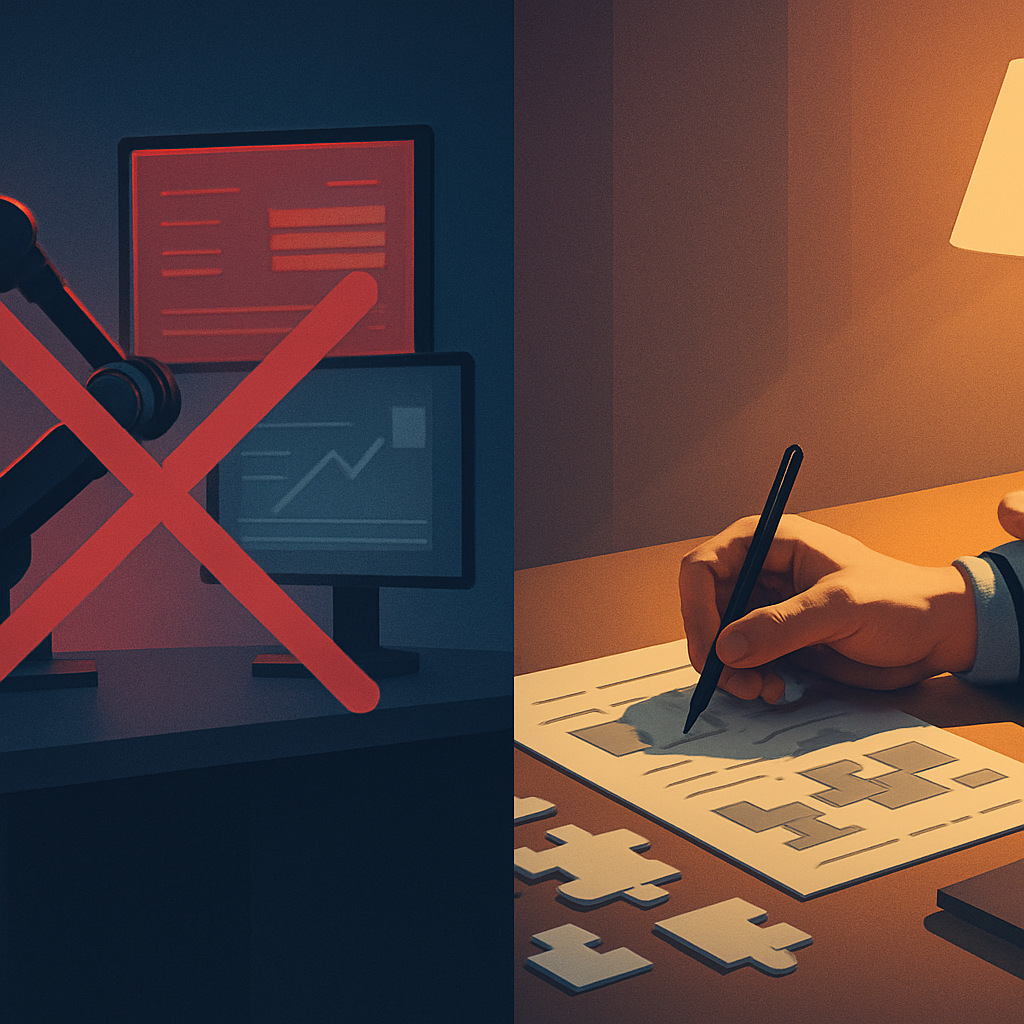 Automation is not always the right answer, and choosing manual execution can be the most cost-effective and lowest-risk decision a business makes. This post maps the specific conditions where staying manual outperforms building a workflow.
Automation Has a Failure Mode No One Talks About
Knowing when not to automate a process is as valuable as knowing when to do it. Most software vendors skip that question entirely, because the answer sometimes points away from a sale. The result is a growing pile of automation projects that consumed budget, created brittle workflows, and then quietly got abandoned. Understanding the conditions that favor manual execution saves money, reduces risk, and keeps your team from building solutions to problems that do not exist.
What Makes a Process a Good Automation Candidate
Before examining where automation fails, it helps to name what it requires. A process is generally automatable when it has:
- High volume or high frequency (the task runs many times)
- Consistent inputs and predictable rules
- A clearly defined output that can be verified
- Low tolerance for the cost of human repetition
When those conditions are absent, the economics shift quickly. A task that runs twice a month with slightly different inputs each time may cost more to automate than to simply do by hand. The calculation is not complicated, but it requires honesty about where the process actually sits.
Three Conditions Where Manual Is the Right Call
Low Volume
Volume is the most overlooked variable in automation decisions. Building a reliable automated workflow takes real engineering time: mapping inputs, handling exceptions, testing edge cases, writing documentation, training users. For a process that runs four times a year, that investment rarely pays back.
A useful rough test: estimate how many hours the manual process consumes in a year, then estimate the engineering hours to automate it. If the ratio is under 3:1 in favor of the manual side, the numbers rarely work unless the task requires a skill that is genuinely scarce. At very low volumes, a checklist or a simple standard operating procedure delivers nearly all the consistency benefit at a fraction of the cost.
High Variability
Automation runs on rules. When a process has too many exceptions, the rule set grows until it collapses under its own weight. This is one of the most common causes of failed automation projects: the process looked standard on a whiteboard but proved highly variable in production.
Signs of problematic variability include:
- Experienced staff regularly make judgment calls that no policy document fully explains
- Inputs arrive in inconsistent formats or from inconsistent sources
- The output requires context that a machine cannot easily observe (customer relationship history, tone of a conversation, organizational politics)
- The definition of "correct" shifts depending on circumstances
In these situations, a skilled human is not a bottleneck to be engineered around. The human is the solution. Automating around them risks producing outputs that are technically correct by the rule set and practically wrong for the situation.
Regulatory or Procedural Uncertainty
Regulated environments add a third constraint. When a process sits inside a compliance framework that is actively evolving, building automation against current rules can leave an organization with a workflow that is outdated by the time it reaches production. Worse, an automated process that produces non-compliant outputs at scale creates a much larger problem than a manual one that can be corrected mid-stream.
This applies to any industry where documentation requirements, approval structures, or data handling rules change frequently. Automating a process that has not fully stabilized locks in assumptions. Changing an automated workflow later requires engineering time and carries its own risk of introducing errors. In genuinely uncertain regulatory environments, manual execution with solid documentation often offers lower total risk.
The Hidden Costs That Make Automation Look Cheaper Than It Is
Automation projects tend to be costed against the direct labor of the task they replace. They are rarely costed against the full picture. A more complete accounting includes:
- Initial build and integration time
- Testing and validation across edge cases
- Ongoing maintenance as upstream systems change
- Monitoring and error handling
- Retraining when the process itself changes
- The cost of errors produced at scale before they are caught
Manual processes have their own costs, but those costs are usually visible and largely linear. Automation costs front-load, then tail off, but they rarely reach zero. If a process runs infrequently enough, or changes often enough, the tail never drops far enough to justify the upfront investment.
When Partial Automation Serves Better Than Full Automation
A binary choice between full automation and pure manual execution misses a third path that often works better. Many processes benefit from automating the predictable parts while leaving judgment-intensive steps to a person.
Consider a customer onboarding process. Data collection, form routing, identity verification checks and CRM record creation might automate well. The relationship conversation that determines how to position services for a specific customer probably does not. Treating those as separate steps, each evaluated on its own terms, produces a better outcome than trying to automate the whole sequence or abandoning the idea entirely.
This is what process-level thinking actually looks like: weighing each step of a workflow individually, considering every available modality (hardware, software, documented procedure, trained staff) against the specific requirements and economics of that step. The goal is the best outcome for each step, not the highest percentage of automation across the process.
When Not to Automate a Process: A Practical Summary
Stepping back from automation makes sense when one or more of the following applies:
- The task runs fewer than a few dozen times per year and the manual execution time is modest
- The inputs or outputs vary too widely for a stable rule set to handle reliably
- Skilled judgment is genuinely irreplaceable at a step, not just habitual
- The regulatory or procedural environment governing the process is actively changing
- The cost of errors produced at scale exceeds the cost of human review
- The process is likely to change significantly within the payback period of the automation investment
None of these conditions mean automation is forever off the table for a given process. They mean it is off the table now, and that choosing manual execution is a deliberate, defensible decision rather than a failure of ambition.
Honest Evaluation Is the Starting Point
The push to automate everything is understandable. The tools have improved, the costs of AI and software have dropped, and the productivity case for well-chosen automation is real. But the case for a specific automation depends entirely on the specific process, its volume, its variability, its regulatory context, and its likely trajectory.
Organizations that evaluate those factors honestly, including the null option of doing nothing, tend to build automation that holds up over time. Those that automate first and evaluate later tend to accumulate technical debt disguised as operational efficiency.
The question is never "can this be automated." The question is whether automating it produces a better outcome than the realistic alternatives, at a cost that makes sense given the actual volume and risk profile of the process.
If you are evaluating a process and want a structured analysis that includes the option to leave it manual, reach out to Intellimate AI to work through the economics together.
Tags