
Vision, Sensors, and Cameras in Manufacturing: Choosing the Right Detection Modality
November 5, 2026
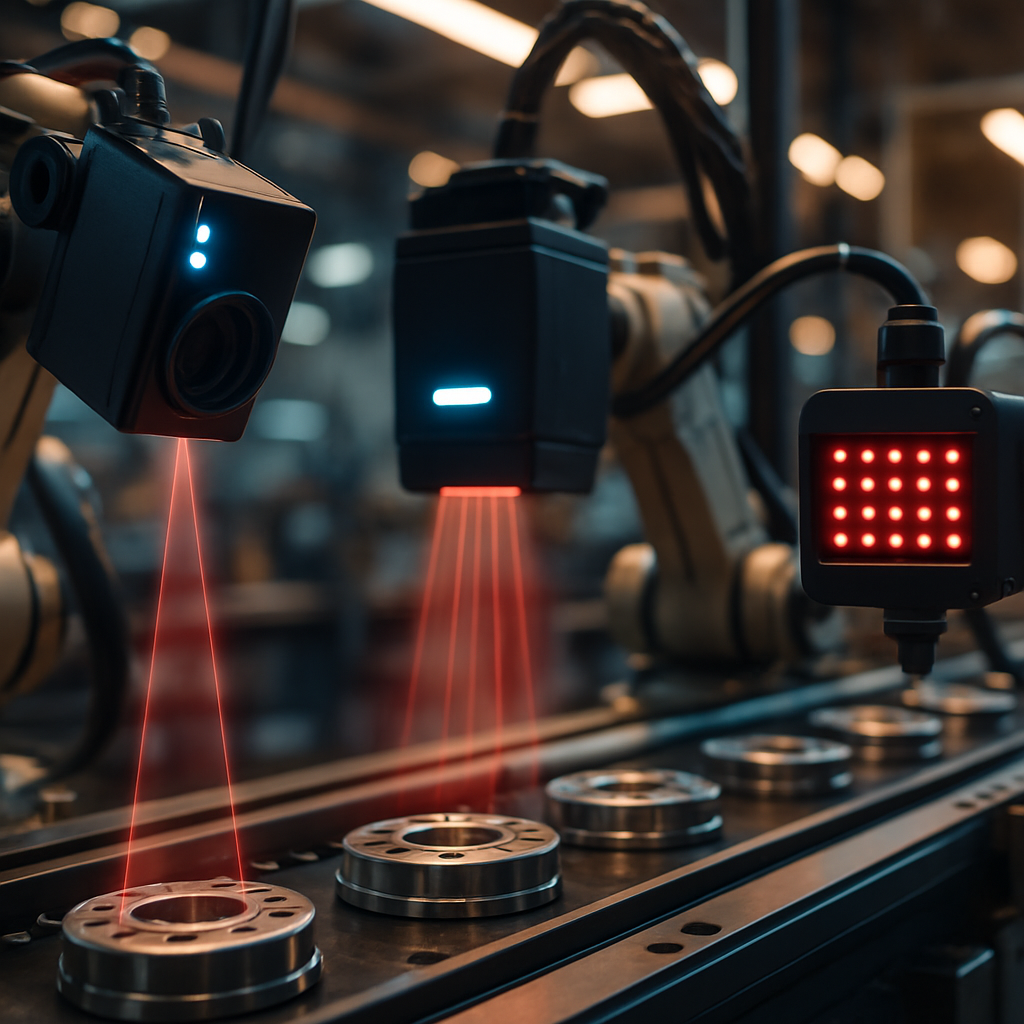 Not every detection problem on a manufacturing line needs a vision system, and not every inspection task can be handled by a simple sensor. This post maps discrete sensors, industrial cameras, and machine vision systems across cost, accuracy, setup complexity, and maintenance so engineers and operations teams can match the right modality to the process before committing to hardware.
Three Ways to See a Manufacturing Line
The vision sensors cameras manufacturing comparison that most engineers eventually face comes down to a simple question: how much does the process actually need to "see"? A photoelectric sensor that detects whether a box is present costs a fraction of a full machine vision system, and for many applications it does the job just as well. Choosing the wrong tier in either direction wastes money or misses defects. This post lays out each modality, what it does well, where it falls short, and how to think through the decision before committing to hardware.
The Three Modalities in Plain Terms
Manufacturing detection breaks into three broad tiers. Each one is built on different physics, produces a different kind of output, and carries a different cost and maintenance profile.
Discrete Sensors
Discrete sensors produce a single binary output: presence or absence, open or closed, above threshold or below it. Photoelectric sensors, inductive proximity sensors, capacitive sensors, and ultrasonic sensors all fall here. They answer one question at a time.
A photoelectric sensor on a conveyor tells the PLC that a part has arrived. It cannot tell you which part, whether the label is correct, or whether the cap is crooked. That limitation is also the strength: the sensor is simple, fast, cheap to replace, and rarely needs calibration beyond an initial setup.
- Typical cost: tens to low hundreds of dollars per sensor
- Output: digital signal (on/off) or an analog value (distance, level)
- Latency: microseconds to low milliseconds
- Maintenance: replace on failure; minimal ongoing tuning
Cameras Without Vision Intelligence
A camera by itself produces an image, nothing more. In manufacturing, cameras in this tier are often used for operator monitoring, manual review stations, or raw data capture piped elsewhere for analysis. This includes USB industrial cameras, GigE Vision cameras connected to a PC running simple recording software, and barcode scanners that use a camera sensor but apply fixed decoding logic.
The camera without onboard or downstream intelligence is flexible in what it can capture but requires a human or a separate system to interpret the image. This tier is appropriate when the process needs a visual record, when an operator needs a live view, or when images will feed a system described in the next tier.
- Typical cost: a few hundred to a few thousand dollars, depending on resolution and interface
- Output: raw image or video stream
- Latency: depends entirely on downstream handling
- Maintenance: lens cleaning, cable management, possible lighting upkeep
Machine Vision Systems
Machine vision combines a camera with optics, controlled lighting, and image-processing logic that makes a decision autonomously. A smart camera or vision sensor from any major industrial supplier does this in a single housing. A PC-based vision system separates the camera from the processing hardware but follows the same logic: capture, process, decide, output a pass or fail signal to the line.
This tier can measure dimensions, verify label placement, read characters or barcodes, detect surface defects, and distinguish between part types. It is doing what the discrete sensor does, but over a much richer picture of the part.
- Typical cost: several thousand to tens of thousands of dollars per inspection station
- Output: structured data (pass/fail, measurement values, detected features) plus optional image logging
- Latency: milliseconds to tens of milliseconds per inspection cycle
- Maintenance: lighting replacement cycles, lens cleaning, model revalidation when parts or packaging change
Comparing Modalities Across the Decisions That Matter
Accuracy and Defect Sensitivity
Discrete sensors are highly accurate at the task they are built for and nearly useless for anything else. A photoelectric sensor will reliably detect whether a bottle is present, but it cannot detect a cracked bottle.
Machine vision systems catch defect types that no discrete sensor can see: wrong color, missing ink, surface scratches, dimensional variation, misaligned components. That capability comes at a cost, including a longer setup process and ongoing maintenance when the product line changes.
Setup and Integration Complexity
Discrete sensors wire into the PLC directly. Setup takes minutes to hours. Machine vision systems require lighting design, lens selection, field-of-view calculation, trigger synchronization with the line, and inspection logic configuration. A well-executed vision system setup runs from days to weeks depending on complexity.
Neither is inherently harder than the other in proportion to what the process needs. The problem is applying the complex solution to a simple problem, or the simple solution to a complex one.
Cost Over the Equipment Life
The acquisition cost difference is significant, but so is the maintenance delta over time. Discrete sensors fail and get replaced cheaply. Vision systems require lighting that degrades, optics that accumulate contamination, and inspection models that need revalidation when part geometry or packaging artwork changes. Budget for those ongoing costs when comparing options.
Speed
High-speed discrete sensors operate at microsecond response times. Machine vision systems processing a full-resolution inspection may take 10 to 100 milliseconds depending on the algorithm complexity and hardware. For most production rates this is fine. For very high-speed lines measuring in parts per second, the processing time of a vision system must be matched carefully to throughput requirements.
Where the Vision Sensors Cameras Manufacturing Comparison Breaks Down
The modality comparison stops being clean once machine learning enters the picture. Classic machine vision uses deterministic rules: if the edge is within these pixel coordinates, pass. Modern AI-based inspection uses trained models that learn what a good part looks like from examples, and can generalize to defect types that a rules-based system would miss.
That capability shift changes the maintenance model, the validation approach, and the appropriate use cases. A trained model may handle natural variation better than a rules-based system but requires a labeled image dataset to build and a retraining plan when the product changes significantly.
This is the territory a separate post on computer vision in manufacturing covers in depth. The framing above gives enough context to understand where that layer sits in the stack relative to the hardware choices described here.
A Practical Decision Path
Start with the simplest question: does the process need to distinguish between more than two states? If the answer is no, a discrete sensor is the right tool. If the answer is yes, move to the camera question: is the inspection decision something a human could reliably make in a fraction of a second by looking at an image? If yes, a machine vision system is worth evaluating. If the inspection involves subtle variation that even experienced operators sometimes miss, or if the definition of a defect changes with context, AI-based inspection becomes relevant.
The economic test runs alongside that capability test. Machine vision systems require engineering time to specify, integrate, validate, and maintain. If the defect rate for the application is low and the consequence of a miss is minor, the cost of a full vision system may not return the investment. If the consequence of missing a defect is a recall or a safety incident, the economics shift decisively toward better detection.
A few questions worth answering before choosing:
- What specific defect or condition needs to be detected?
- What is the consequence of a false positive (line stoppage) versus a false negative (defect passes through)?
- How often does the product or packaging change?
- What is the available cycle time per inspection?
- Who will maintain and revalidate the system after deployment?
Choosing Based on the Process, Not the Technology
The right detection modality is determined by what the process actually requires, not by what is technically impressive or recently available. A photoelectric sensor on a fill-level application is not a compromise; it is the correct solution. A machine vision system on a complex label inspection is not overengineering; it is the appropriate tool for work a sensor cannot do.
Getting that match right before purchasing hardware saves time during integration and avoids retrofitting months later. For processes that sit at the boundary where rules-based vision starts to struggle, the next post in this series covers how AI-based computer vision changes the decision framework.
Read the computer vision in manufacturing post to see where trained inspection models fit relative to the hardware tiers covered here.
Tags