
How to Choose the Right Modality for Each Step in an Automation Workflow
September 28, 2026
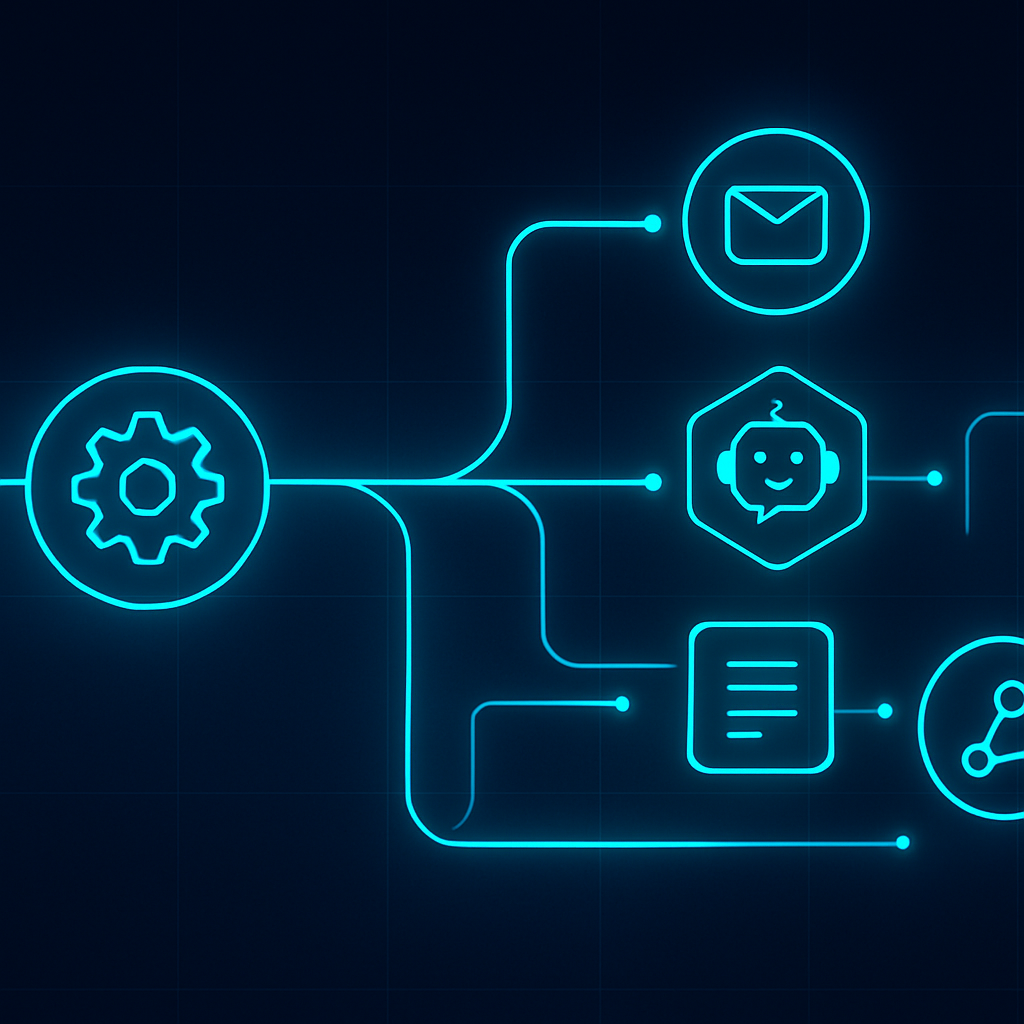 Most automation projects fail because buyers choose tools before they choose the right category of solution for each step. This guide explains how to evaluate hardware, robotics, vision, ML, AI, and software systematically against what each process step actually requires.
Why Modality Comes Before Tools
Choosing the wrong category of solution for a process step is the most expensive mistake in automation planning. Automation workflow modality selection, deciding whether a given step needs hardware, robotics, computer vision, machine learning, conventional software, or some combination, should happen before anyone opens a vendor catalog or writes a line of code. Most projects skip this step entirely, which is why so many automation rollouts stall, cost twice the estimate, or produce systems that workers route around.
This guide explains how to evaluate each modality honestly, step by step, so that the choice is driven by what the process actually requires rather than by what a vendor happens to sell.
What "Modality" Means in an Automation Context
A modality is simply the category of solution used to accomplish a specific process step. The main options are:
- Hardware and fixturing, physical devices, sensors, jigs, or conveyors that control movement or position
- Robotics, programmable mechanical systems that move, handle, or assemble physical objects
- Computer vision, cameras and image-processing systems that inspect, identify, or guide other systems using visual data
- Machine learning (ML), models trained on historical data to classify, predict, or detect patterns that rules cannot capture
- AI, systems capable of reasoning, generating, or making decisions across unstructured inputs such as text, documents, or voice
- Software and workflow automation, rule-based programs that move data, trigger actions, or coordinate systems without physical or probabilistic components
- Controlled documents, structured procedures, work instructions, or checklists that standardize human execution
These are not competing products from the same shelf. They solve different categories of problem, carry different cost structures, and fail in different ways. The job is to match each one to the right step.
A Framework for Automation Workflow Modality Selection
The selection process has four stages: understand the step, diagnose what is making it hard, identify which modality addresses that specific difficulty, and then pressure-test the economics before committing.
Stage 1: Describe the Step in Physical and Informational Terms
Before evaluating any solution, describe what the step actually does. Two questions are useful here.
First: does the step involve moving, positioning, or transforming a physical object? If yes, the solution set includes hardware, fixturing, and robotics. Software alone cannot move a box.
Second: does the step involve making a decision, reading information, or routing data? If yes, the solution set includes software automation, ML, AI, and controlled documents. A robot arm cannot decide whether a customer complaint is urgent.
Some steps involve both. A quality inspection line might require a camera (vision) to capture an image, an ML model to classify a defect, and a software trigger to route the item to the right bin. Those three modalities work together, but each addresses a distinct sub-step.
Stage 2: Diagnose the Source of Difficulty
Every step that needs automating is hard for one of a small number of reasons. Identifying which reason applies determines which modality is relevant.
- Volume and speed. The task is straightforward but happens faster or more often than people can handle. This is usually a software automation or hardware problem, not an AI problem.
- Variability in physical form. Parts, packages, or materials arrive in inconsistent sizes, positions, or orientations. This points toward vision and robotics rather than fixed hardware alone.
- Variability in data or language. Inputs arrive as unstructured text, mixed formats, or spoken language. This is where ML and AI become relevant.
- Rare but consequential failure modes. The step works fine most of the time, but misses cause serious problems. Vision or ML-based inspection is worth evaluating here.
- Inconsistent human execution. People perform the step differently, leading to quality variation. A controlled document or standardized checklist often fixes this before any technology is needed.
The last point deserves emphasis. Adding AI to a step that simply lacks a clear procedure is a costly way to avoid writing a procedure. A well-designed work instruction is sometimes the right answer, and it costs a fraction of a software deployment.
Stage 3: Apply the Modality to the Specific Difficulty
Once the source of difficulty is clear, the appropriate modality follows more directly. A few practical patterns:
If a step requires physical precision at high throughput, fixturing and conveyors should be evaluated first. Adding a robot before the fixture is designed means the robot compensates for a positioning problem that a well-made jig would eliminate for far less money.
If a step requires reading a document, extracting specific fields, and routing based on what it finds, software automation handles it well when the documents are structured and consistent. When the documents vary significantly in format or content, ML-based extraction becomes worth the added complexity.
If a step requires a judgment call based on context that changes case by case, a large language model or an AI reasoning system may be appropriate. But "judgment call" should be tested carefully. Many decisions that feel complex are actually rule-based once the rules are written down. Those belong in software, not AI.
If a step requires detecting whether a physical product meets a visual standard, computer vision is the right starting point. The question is then whether the inspection criteria are consistent enough for rule-based vision algorithms or variable enough to require an ML model trained on examples.
Stage 4: Test the Economics Before Committing
Each modality carries a different cost structure. Hardware and robotics tend to require higher upfront capital but low ongoing cost. Software and ML systems often have lower setup costs but ongoing licensing, maintenance, and retraining expenses. AI systems add inference costs that scale with usage.
A useful exercise is to estimate three numbers for each option being considered:
- The cost to build or deploy
- The annual cost to maintain and operate
- The value recovered per year from eliminating the problem
Divide the total cost by the annual value. If payback takes longer than three years for a modality that is not a competitive requirement, the economics should prompt a simpler solution. A $200,000 robotics cell that saves $40,000 a year in labor has a five-year payback. A fixture redesign that achieves the same outcome for $15,000 has a far better case.
Common Mismatches and What They Cost
The most frequent mismatch is applying AI to a data-quality problem. If the underlying data is incomplete, inconsistently entered, or captured in the wrong place in the process, an AI layer on top produces unreliable outputs. The right fix is usually a data capture redesign, which is a workflow or controlled document problem.
A second common mismatch is using a robot where a fixture would do. Robots are flexible and programmable, which makes them attractive. But flexibility costs money to configure, program, and maintain. When a part can be reliably positioned by a well-designed guide rail or jig, adding a robot to handle the positioning is waste.
A third mismatch is deploying a rule-based software system on a step where the variation is too high for rules to cover. The system works in the common case but fails on exceptions, pushing more work to humans than the original process required.
Using Multiple Modalities Together
Real processes rarely fit a single modality end to end. The practical skill is mapping each step individually and selecting the appropriate solution for that step, then designing how the outputs of one feed into the next.
A receiving workflow, for example, might use a barcode scanner (hardware) to capture an item, a software system to match it against a purchase order, an ML model to flag anomalies in quantity or condition, and a controlled document to guide the operator's response to those flags. Four modalities, each doing the task it is suited for.
When modalities hand off to each other, the interface between them needs explicit design. What data format does the ML model output? What does the software system expect as input? Mismatches at the handoff are where integration projects go wrong.
Starting the Evaluation on a Real Process
The best way to apply this framework is to pick one process with a known pain point, map every step, and classify each step by what makes it difficult. From there, the modality options become specific rather than abstract, and the cost-benefit comparison has real numbers to work with.
Intellimate AI's Know layer is designed specifically to do this evaluation across every relevant modality before any implementation decision is made. To see how that evaluation works on a process in your organization, reach out and request a process assessment.
Tags