
How the 5-Step AI Implementation Process Works — and What Happens at Each Stage
October 22, 2026
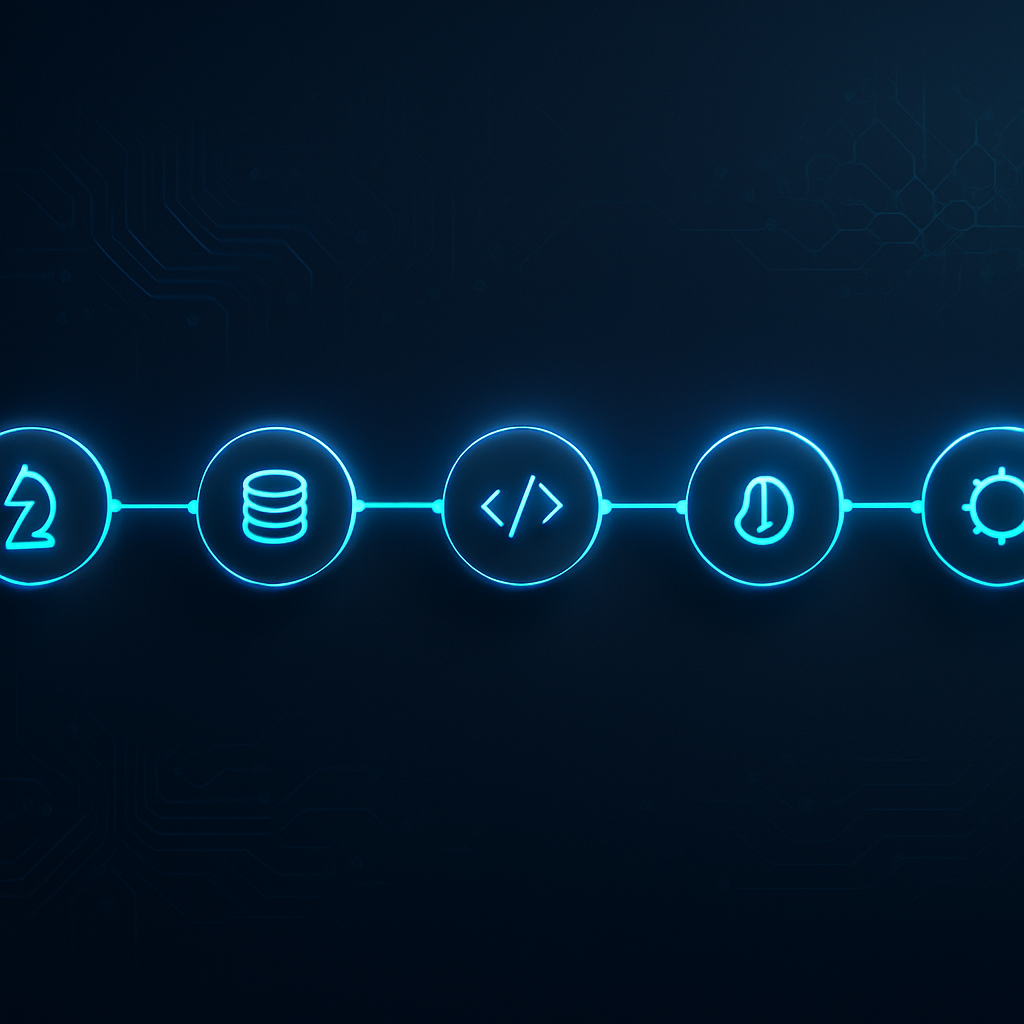 Intellimate AI's 5-step AI implementation process maps every task, selects the right modality, and applies deterministic economics before a single line of code is written. This guide walks through each stage in plain terms.
What the 5-Step AI Implementation Process Actually Does
The 5-step AI implementation process used by Intellimate AI is a structured engineering framework, not a generic consulting checklist. Each step has a specific purpose: to weigh every available modality for a given process, assign deterministic economics to each option, and produce a build path that a business can actually execute. Here is what happens at each stage and why the sequence matters.
Why a Structured Process Beats Ad Hoc AI Adoption
Most organizations approach AI by picking a tool and asking what it can do for them. That works occasionally, but it skips the step of understanding what the process actually requires. A packing line with variable product sizes needs different capabilities than a document approval workflow. Treating them the same way produces mediocre results in both cases.
A structured process forces the question in the right direction: what does this specific step need, and which modality, at what cost, delivers that reliably? Modalities here means the full range of options: hardware, fixturing, robotics, computer vision, machine learning, AI, software, and controlled documents. Any one of those might be the right answer for a given step. Often, the best solution combines several.
The 5-Step AI Implementation Process, Stage by Stage
Step 1: Process Decomposition
The work begins by mapping the target process at the task level. Not at the department level, not at the workflow level. Each discrete action gets documented: who does it, how often, what inputs it consumes, what outputs it produces, and where it fails.
This matters because AI rarely improves a whole process at once. It improves specific steps. A receiving clerk who visually checks incoming parts, logs them in a spreadsheet, and flags discrepancies is performing three distinct tasks. Each one has different automation potential and a different cost-to-automate profile. Lumping them together produces a plan that is vague at best.
The output of Step 1 is a task-level map with every step labeled by its data type, frequency, exception rate, and current cost.
Step 2: Modality Selection
With the process mapped, each task gets evaluated against the full modality spectrum. This is where the framework separates from generic AI consulting. The question is not "can we use AI here?" The question is which modality, or combination, is appropriate for this task at this scale.
For a task like visual defect detection on a production line, the options might include:
- A rules-based machine vision system using calibrated cameras and lighting fixtures
- A trained ML model running inference on image data
- A combination of fixturing to standardize position, plus a lightweight classifier
- A fully robotic cell with integrated vision
Each option has a different accuracy profile, maintenance requirement, and upfront cost. Modality selection produces a shortlist for each task, not a single answer. The next step is what narrows it down.
Step 3: Deterministic Economics
This step assigns real numbers to the shortlisted options from Step 2. Not ballpark figures. Deterministic economics means building a cost model where every variable is defined: hardware cost, integration cost, training data cost, ongoing inference cost, maintenance cost, and the cost of failure when the system gets something wrong.
It also models the current-state cost. If a human inspector catches 97% of defects at a fully-loaded labor cost of $X per hour and inspects Y units per shift, that is the baseline. Any proposed solution has to beat that baseline on the metrics that matter to the business, whether that is cost per unit, defect escape rate, throughput, or all three.
The output is a comparison table. Each modality option, priced out against the baseline, with the break-even point and the risk-adjusted return. Decision-makers can read it without an engineering background, which is intentional.
Step 4: Solution Engineering
Once a modality is selected based on the economics, the engineering work begins. This is where specifications get written: hardware configurations, data pipeline design, model architecture choices, software integration requirements, and the controlled documents that govern how the solution runs.
Controlled documents are worth naming specifically. They include operating procedures, calibration schedules, retraining triggers, and escalation protocols. A machine vision system that was accurate at commissioning will drift if no one re-calibrates the lighting or retrains the model when the product mix changes. The documentation prevents that drift from being invisible until it becomes a problem.
Solution engineering also covers the human touchpoints. Most implementations have steps that stay manual by design, either because automation is not cost-justified or because the task requires judgment that cannot yet be encoded reliably. Those handoff points need to be engineered as carefully as the automated ones.
Step 5: Staged Deployment and Measurement
The solution goes live in stages, not all at once. Each stage has a defined measurement gate: if the system performs within the modeled parameters, the next stage proceeds. If it does not, the stage stops and the gap gets diagnosed before moving forward.
This is not a soft agile metaphor. It is a hard stop tied to the economics from Step 3. If the defect escape rate at the pilot stage is outside the predicted range, that number affects the payback period. The business needs to know that before scaling the solution across five production lines.
Measurement at this stage also populates the feedback loop for future process steps. A company that runs this framework once builds institutional knowledge about what modality choices tend to work in their environment. The second implementation is faster and more accurate than the first.
How the Framework Applies to Non-Manufacturing Processes
The five steps were described above using a production line example because it is concrete. The same logic applies to back-office processes, professional services workflows, and multi-site agency operations.
A document-heavy approval process, for example, might have ten discrete tasks. Process decomposition reveals that three of them involve extracting structured data from unstructured text, two involve routing decisions based on that data, and five involve human review of edge cases. Modality selection might recommend a document AI model for the extraction steps, a rules engine for routing, and a software interface that surfaces the edge cases to a reviewer with all context pre-populated.
The economics step then tells the business whether the current cost of having people do all ten steps manually justifies the build cost. If the volume is low, the answer might be no. That is useful information. It prevents a six-month build project that never pays back.
What Makes This Process Different from a Generic AI Rollout
Three things distinguish this approach:
- Modality agnosticism. The framework does not start with AI and work backward. It starts with the task and selects the right tool, which might not be AI at all.
- Deterministic economics. Every option is priced against a defined baseline. There is no "expected ROI" language without numbers behind it.
- Controlled documents as a first-class output. The system is not complete until the documentation that governs it is written. That documentation is part of the solution, not an afterthought.
Generic AI implementation plans skip at least one of these. Usually the economics and the documentation. That is why a significant number of AI pilots never reach production: the business cannot measure whether they worked, and no one wrote down how to maintain them.
Intellimate AI applies this framework to businesses and agencies equally, because the underlying logic of task decomposition and modality selection does not change based on industry. The specific modalities that appear in the shortlist do change, and that is exactly what Step 2 is designed to surface.
To see how the framework applies to a specific process in your operation, reach out to Intellimate AI to start a scoping conversation.
Tags