
How Robotics and AI Work Together — and When to Use One Without the Other
October 16, 2026
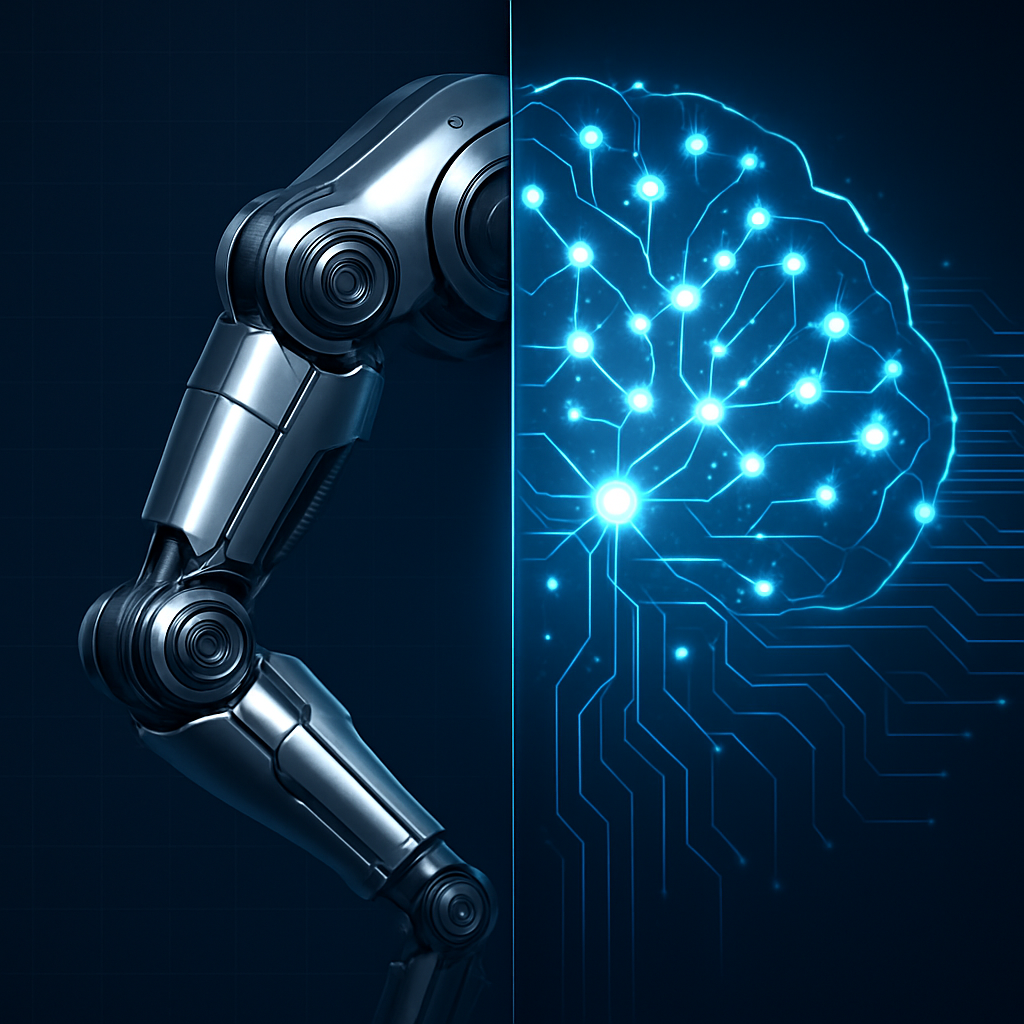 Robotics and AI are distinct technologies that each solve different problems. This guide separates the two and explains the specific process conditions that justify using each alone, or combining both.
Robotics and AI Are Not the Same Thing
A robotics and AI integration guide has to start with a basic clarification: robotics and AI are distinct technologies that happen to work well together under specific conditions. Neither one requires the other. A robotic arm can move with perfect repeatability along a fixed path without any machine learning involved. An AI model can analyze product defect images from a stationary camera without any motion system attached. Conflating the two leads buyers to pay for capabilities they do not need, or miss the simpler solution that would have worked fine.
This post separates the two, explains what each actually does, and lays out the process conditions that favor each alone, or both together.
What Robotics Does, and Does Not Do on Its Own
Robotics is about physical movement and mechanical action: moving objects from one location to another, applying torque, assembling components, welding seams, dispensing fluids. A properly programmed robot is deterministic, given the same input conditions, it performs the same motion every time. That reliability is the whole point.
Traditional industrial robots operate from fixed programs. They know where to pick from and where to place because the world around them is engineered to be consistent: parts arrive in the same orientation, on the same fixture, at the same time. The robot does not need to think. It needs to execute.
Where robotics alone makes sense
- The task involves repetitive physical motion with tightly controlled inputs
- Part orientation and position are managed upstream (pallets, fixtures, feeders)
- Cycle time consistency is more valuable than adaptability
- The environment is stable and does not change between shifts
- Speed and force requirements are precise and predictable
A classic example: bottling lines in food manufacturing. Bottles arrive in a known position, caps are fed by a consistent vibratory bowl, and the robot applies the same torque every time. Adding AI to that process would add cost and complexity without improving the outcome.
What AI Does, and Does Not Do on Its Own
Artificial intelligence, in the industrial context, is primarily about perception and judgment under variability. Machine learning models recognize patterns in data: images, sensor readings, time-series signals. When inputs change in ways that a fixed program cannot anticipate, AI can still produce a useful output.
AI does not move anything. It has no actuators, no motors, no grippers. A computer vision model that spots a surface crack does nothing about that crack unless something else in the system acts on its output. That "something else" could be a human, an alarm, a conveyor gate, or a robot.
Where AI alone makes sense
- Inspection tasks where human visual fatigue is a quality risk
- Demand forecasting and production scheduling
- Predictive maintenance using vibration, temperature, or current data
- Document classification and work order routing
- Anomaly detection in process data streams
A quality lab using AI to inspect welds from a fixed camera, with a human pulling flagged parts, is getting real value without any motion system. The AI handles the judgment; the human handles the physical response. That is often the right architecture, faster to implement, cheaper to maintain, and easier to validate.
The Robotics and AI Integration Guide: When Combining Both Is Justified
Combining robotics and AI becomes worth the added cost and complexity when the physical environment introduces variability that a fixed robot program cannot handle. The canonical case is bin picking: parts arrive in a bin in random orientations, so the robot cannot move to a pre-programmed position. A vision system using AI identifies each part's pose, and the robot uses that output to plan its grasp. Neither could do the job alone.
Process conditions that justify integration
- Variable part presentation: parts arrive in unknown positions or orientations
- Mixed-SKU handling: the robot must distinguish between product types before acting
- Adaptive path planning: the robot path needs to change based on sensor feedback in real time
- Defect-driven sorting: an inspection result must trigger an immediate physical sort, not a human decision
- Human-robot collaboration zones: the robot must detect and respond to unpredictable human movement
Notice the common thread: the integration is justified when AI judgment needs to be converted into physical action faster or more reliably than a human can provide. If the human-in-the-loop is fine, skip the robotics. If the environment is controlled, skip the AI.
What integration actually costs
AI-guided robotics requires more than bolting a camera to a robot arm. The two systems need to communicate at speed, with latency low enough that the robot acts on current data rather than stale data. Calibration between the camera coordinate system and the robot coordinate system has to be maintained. The AI model has to be retrained when the part mix changes. Failure modes multiply because there are now two complex systems that can disagree with each other.
These are solvable problems, but they take engineering time and ongoing maintenance budget. A buyer who has been told "AI-powered robotics" without a breakdown of those costs may be surprised later.
Common Mistakes When Evaluating Both Technologies Together
Assuming AI makes a robot smarter overall
AI improves specific decisions within a workflow. It does not make a robot generally intelligent or resilient to all conditions. A robot guided by a vision model is still a robot: it will collide with an unexpected obstacle if collision avoidance is not specifically engineered. The AI handles perception; everything else requires its own solution.
Underestimating the controlled-environment option
Before adding AI to a robot installation, it is worth asking whether the variability problem can be solved mechanically. A vibratory bowl feeder that orients parts before the robot picks them costs far less than a vision system and eliminates a source of software failure. Mechanical solutions to orientation and feeding problems are underused because they are less exciting to talk about than AI, not because they are inferior.
Skipping the step-by-step process evaluation
The right question is not "should we use AI and robotics?" but "what does each step of this process actually require?" A palletizing cell might justify a robot with no AI at all. The upstream quality gate that feeds it might justify AI with no robot. Evaluating each step independently produces a better total solution than picking a technology platform and fitting the process to it.
A Practical Framework for Choosing
For each process step, work through three questions in order.
- Is there physical work to be done? If yes, robotics (or another actuation method) is on the table. If no, skip it.
- Is there variability that a fixed program cannot handle? If yes, perception or judgment support is needed, AI, sensors, or a human. If no, a fixed program may be sufficient.
- Does the judgment need to trigger physical action faster or more reliably than a human can manage? If yes, integration of AI and robotics is worth evaluating. If no, keep them separate.
This order matters. Starting with question three leads organizations to buy integrated systems for problems that question one or two would have resolved with a simpler tool.
Why "AI-Powered Robotics" Is a Marketing Category, Not an Engineering Answer
Vendors use "AI-powered robotics" as a platform label. The phrase signals modernity, but it does not tell a buyer which process problems the combination actually solves versus which ones it leaves untouched. A system can have an AI component that does very little consequential work while the robot executes a mostly fixed program. The marketing is not wrong, exactly, but it skips the step where someone explains what the AI is deciding and what happens if it decides incorrectly.
Buyers who ask those questions specifically, what judgment is the AI making, how often does it err, and what is the fallback, tend to get far more honest proposals.
The practical step from here is to map your target process step by step, assign each step to the right modality based on what it actually requires, and get a cost estimate for that specific configuration rather than for a platform category.
Tags