
Fixturing in Automation: What It Is, When It Matters, and How to Evaluate It
October 20, 2026
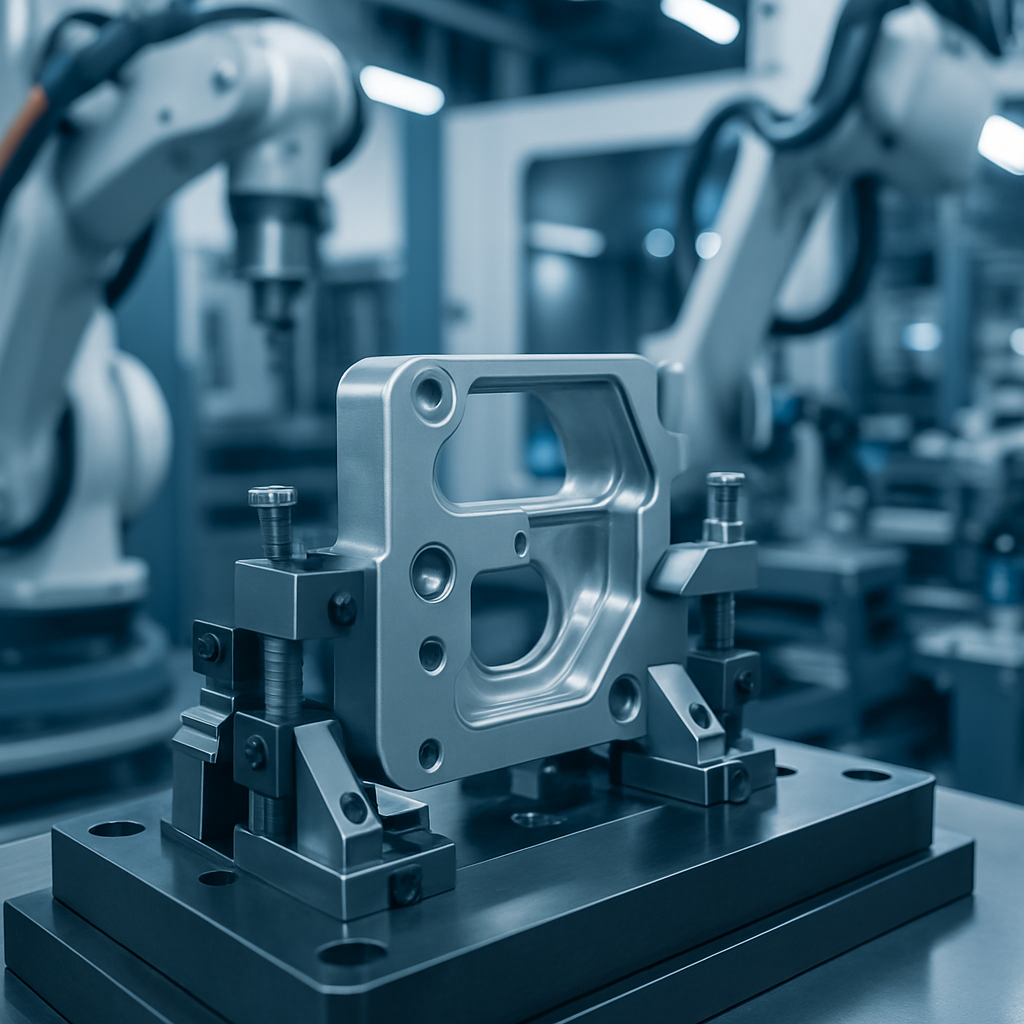 Fixturing is one of the most overlooked modalities in automation planning. This post explains what fixtures do, when they outperform software-only approaches, and how to evaluate their cost against alternatives at each process step.
What Fixturing Actually Does in an Automation System
Fixturing in automation explained simply: it is the physical infrastructure that holds, aligns, orients, or constrains a part so that every other system in the process (a robot arm, a vision camera, a laser, a press) can act on it with precision and consistency. It is not glamorous, it rarely appears in vendor demos, and it is almost never mentioned in AI automation discussions. That is a problem, because skipping fixturing evaluation is one of the most common reasons automation projects underperform after installation.
This post explains what fixturing is, what process steps it serves, how to think about its cost, and when a software-only or robotics-only approach is the right answer instead.
The Basic Mechanics of Fixturing
A fixture is any device that locates and holds a workpiece in a defined, repeatable position. The form it takes depends entirely on the part and the process:
- A machined aluminum nest that cradles an injection-molded housing so a camera always sees the same face
- A vacuum chuck that holds a thin sheet flat while a pick-and-place machine works on it
- A pneumatically actuated clamp that grips a weldment to within a tenth of a millimeter for a robotic welder
- A simple peg-and-slot locator that an operator drops a part into before pressing a foot pedal
These are very different objects, but they do the same job: they remove positional uncertainty from the part so that downstream systems do not have to compensate for it. That matters more than most engineers initially expect, because positional uncertainty compounds. A robot that can place to ±0.5 mm is not useful if the part it is reaching for can be anywhere within a 10 mm zone.
Active vs. Passive Fixturing
Passive fixtures are static. They rely on gravity, geometry, or a simple mechanical stop to locate the part. They have no moving parts and require almost no maintenance. A machined nest is a passive fixture.
Active fixtures use actuation, usually pneumatic or electric, to clamp or adjust. They are appropriate when parts vary in size within a tolerance band, when clamping force is required to resist process loads, or when the fixture needs to release quickly in a high-cycle application.
The distinction matters when you are estimating cost and complexity. Passive fixtures are often a few hundred to a few thousand dollars. Active fixtures, especially those with sensors and feedback, can run from several thousand to tens of thousands of dollars per station, depending on the number of axes and the precision required.
When Fixturing Matters More Than Software
A common instinct in automation planning is to treat variation as a software problem. If a part position varies, add a vision system. If orientation is inconsistent, write a correction algorithm. This instinct is not wrong, but it has limits. Vision and AI can compensate for variation, but compensation has a cost: processing time, hardware, calibration, and ongoing maintenance of the model.
Fixturing addresses the same problem upstream, at lower ongoing cost, with deterministic results. A part that is always in the same place does not need a vision correction loop.
Process steps where fixturing typically earns its cost include:
- High-speed assembly where cycle time budget leaves no room for vision-based correction
- Precision joining such as welding, bonding, or press-fit, where positional tolerance is tighter than a robot can achieve without a reference datum
- Inspection stations where a camera needs a guaranteed viewing angle to make a reliable measurement
- Multi-step processes where a part must transfer between stations while preserving its orientation
- High-volume, long-run production where the per-unit cost of a fixture amortizes quickly
When Fixturing Is Not the Right Answer
Fixturing is a poor choice when part geometry changes frequently. A fixture is specific to a part family. If your product line shifts often, you may spend more on retooling fixtures than you would on a flexible robot end-effector or a vision-guided system that adapts to new geometry through software updates.
Low-volume, high-mix environments generally favor flexible gripping and intelligent guidance over hard tooling. The economics flip: a fixture that costs $8,000 and handles one part number is a liability when that part number represents only 200 units per year.
How to Evaluate Fixturing as a Modality Option
Treating fixturing as a first-class option in a process design means asking four questions at each process step before committing to any solution.
1. What is the positional requirement at this step?
Define the tolerance the downstream system actually needs. A label applicator may need ±2 mm. A laser marking system may need ±0.1 mm. The tighter the requirement, the more valuable a precise fixture becomes, because the alternative is a more expensive and complex guidance system.
2. What is the variation in incoming parts?
Parts that arrive from an upstream conveyor in random orientations need either a vibratory bowl feeder and passive nest, a robot with vision guidance, or some combination. Parts that arrive pre-oriented from a tray or pallet may need only a simple locating pin. Knowing the actual incoming variation narrows the fixture design considerably.
3. What does the cost-per-unit math look like?
Fixturing cost is largely upfront. Software and vision systems carry recurring costs in licensing, model retraining, and IT support. For a rough comparison: a passive fixture at $3,000 amortized over 500,000 cycles costs $0.006 per unit. A vision correction system at $15,000 capital plus $2,000 per year in support over five years totals $25,000, or $0.05 per unit at the same volume. At lower volumes, those numbers can reverse entirely. Do the actual arithmetic for your volumes before deciding.
4. What is the maintenance burden?
Passive fixtures wear at locating surfaces over time. Depending on part material and cycle count, a nest may need reconditioning after a few hundred thousand cycles or after several million. Active fixtures add pneumatic fittings, cylinders, and sensors, each of which is a potential failure point. Neither is a disqualifier, but both should appear in the total cost of ownership calculation, not just the purchase order.
Fixturing in the Context of a Full Modality Review
No process step is solved by fixturing alone. A fixture locates the part. Something else acts on it: a robot, a human, a machine tool, a vision system. Fixturing is most valuable when it is designed in concert with the systems that depend on it, not specified after those systems are already chosen.
This is the argument for evaluating all modalities together at each step of a process: hardware, fixturing, robotics, vision, machine learning, software, and the controlled documents that govern how people interact with each. Fixturing that is designed around a robot's native repeatability, the camera's field of view, and the operator's ergonomic reach is a fundamentally different object from a fixture bolted on late to compensate for a system that was not designed with it in mind.
The sequencing matters. A fixture specified early, based on the actual tolerance requirements of the step, shapes what robot, gripper, and vision hardware you need. Specified late, it becomes a workaround, and workarounds compound.
Broad Cost Ranges to Use in Early Planning
These are planning ranges, not quotes. Actual cost depends on material, tolerance, number of part numbers, actuation requirements, and supplier location.
- Simple passive locating nest or stop: $200 to $2,000
- Machined precision fixture for inspection or assembly: $2,000 to $15,000
- Pneumatically actuated clamping fixture: $5,000 to $30,000
- Multi-position or indexing fixture with sensors: $15,000 to $75,000+
- Modular quick-change tooling systems for high-mix lines: $10,000 to $50,000 per station
These numbers exist to anchor early ROI conversations, not to replace engineering scoping. Treat them as order-of-magnitude inputs until a fabricator quotes against actual drawings.
If you are mapping out a process for automation and want a structured way to evaluate which modalities belong at each step, reach out to Intellimate AI to work through the analysis.
Tags