
Fixturing and Hardware in Automation: When Physical Infrastructure Beats Software Alone
October 6, 2026
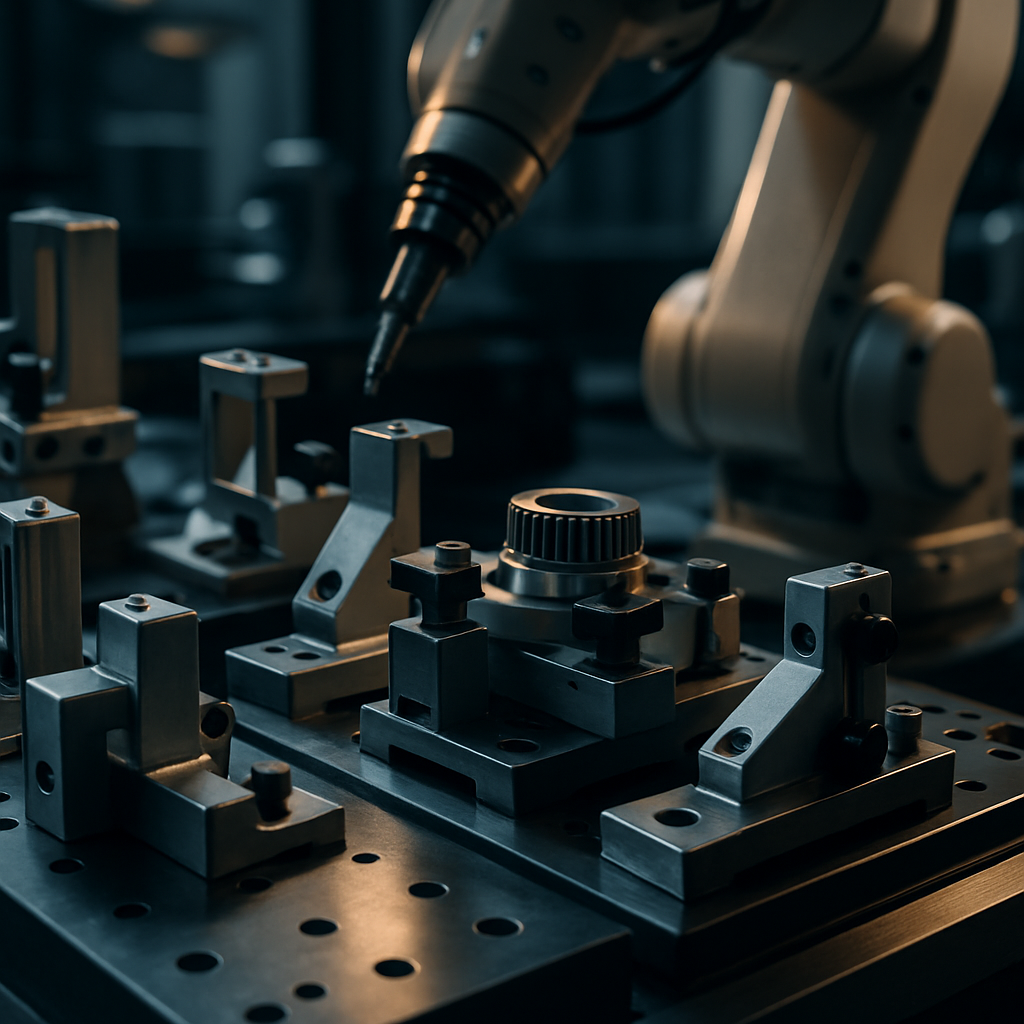 Software cannot solve every process gap. This post explains when hardware fixturing in industrial automation is the smarter, cheaper, or only viable engineering choice, with a practical framework for evaluating each process step.
Physical Infrastructure Is a Legitimate Automation Answer
Hardware fixturing in industrial automation does something no software layer can: it holds a part in exactly the right place, every time, without a sensor array, a model, or a compute cycle. As manufacturers bring production back onshore and discover that AI and software alone cannot close every process gap, the case for physical infrastructure as a first-class engineering decision deserves a direct look.
This is not an argument against software. It is an argument for choosing the right tool at the right process step, which sometimes means bolting a fixture to a table rather than training a vision model.
What Fixturing Actually Does in an Automated Line
A fixture constrains a workpiece. It removes degrees of freedom so that a downstream operation, whether that is drilling, welding, assembly or inspection, can proceed with predictable geometry. The constraint is mechanical. It does not drift with lighting changes, model updates or network latency.
That reliability is the core value proposition. When a part must land within 0.002 inches of the same position on every cycle, a well-designed fixture delivers that without any runtime decision-making. A vision system paired with a robot arm can approach that precision, but it costs more, fails in different ways and requires ongoing calibration.
Fixturing versus vision-guided positioning
Vision-guided positioning makes sense when:
- Part geometry varies across a family of products
- Random bin presentation makes mechanical location impractical
- The line must adapt to new SKUs without tooling changes
Mechanical fixturing makes sense when:
- A single part geometry runs at high volume
- Positional tolerance is tight and consistent
- The cost of a vision system and its integration exceeds the cost of tooling amortized over production volume
Neither option is universally correct. The decision belongs to the economics and physics of that specific process step.
When Hardware Fixturing in Industrial Automation Outperforms Software
High-cycle, single-geometry operations
A stamping line running one bracket design for three years at 600 parts per hour does not need adaptive software. A fixture pin and a clamp define position in under a second with zero computational overhead. Over a three-year run, that simplicity compounds into meaningful uptime and maintenance savings.
Environments that defeat sensing
Weld smoke, coolant mist, metal chips and extreme heat all degrade sensor performance. A camera mounted near a MIG weld station will need frequent cleaning, recalibration or shielding. A fixture does not care about ambient conditions. When the environment is hostile to electronics, mechanical constraint is often the most reliable engineering choice.
Safety and regulatory requirements
Certain operations require a physical stop, not a software interlock, to satisfy safety standards. Machining operations involving rotating tools, for example, often mandate mechanical workholding as a matter of compliance. No software flag substitutes for a properly torqued clamp when a regulation specifies one.
Latency-critical steps
Any process step where timing is measured in milliseconds faces a hard limit on what software can do. A mechanical stop that triggers a pneumatic actuator responds faster than any control loop that reads a sensor, processes data and issues a command. For press operations, snap-fit assembly or high-speed packaging, the physics favor hardware.
The Economics of Choosing Hardware Over Software
Software automation carries costs that are easy to undercount: integration hours, licensing, ongoing model maintenance, IT infrastructure and the engineering time required when something breaks or a dependency changes. A custom fixture carries a one-time tooling cost and occasional wear-part replacement.
The crossover point depends on volume, variety and timeline. A useful way to frame the comparison:
- Tooling cost divided by expected production volume gives a per-unit fixture cost.
- That figure sits against the per-unit cost of a software-driven alternative, including integration, infrastructure and five-year maintenance estimates.
- If the fixture wins on cost and meets the precision requirement, the engineering rationale for software weakens considerably.
This arithmetic is not always straightforward, but running it explicitly prevents the common mistake of defaulting to software because it feels modern, or defaulting to hardware because it feels familiar.
How Intellimate AI Weighs Hardware in Solution Engineering
Intellimate AI treats every process step as an open question. The modalities under consideration at each step include hardware, fixturing, robotics, vision, machine learning, AI, software and controlled documents. No modality is assumed. Each one is evaluated against the process requirement and the economics of that specific operation.
That approach produces recommendations that can look unfamiliar to teams expecting a software-first answer. A solution might specify a pneumatic fixture for one station, a vision inspection system for the next and a simple checklist document for a third. The output reflects what each step actually requires, not a preference for any particular technology category.
For manufacturers returning production onshore, this matters. Plants that have been out of domestic production for years often lack the institutional knowledge to evaluate fixturing options alongside software options. Starting from a blank modality sheet rather than a pre-selected technology stack surfaces options that would otherwise be skipped.
Common Mistakes When Underweighting Physical Infrastructure
Expecting software to solve a geometry problem
A part that arrives at a workstation in the wrong orientation every third cycle has a physical problem. Adding a vision system that detects the wrong orientation and triggers a re-present cycle is a software patch on a fixturing gap. Fixing the upstream feed mechanism or adding a passive orienting feature to the fixture eliminates the root cause.
Treating tooling cost as a barrier rather than a trade-off
Tooling cost is visible and immediate. Software integration cost is distributed across a project and often underestimated. Teams that reject a fixture because of upfront cost and then spend three months integrating a vision system frequently end up with a more expensive and more fragile solution.
Assuming hardware is inflexible
Modular fixturing systems and quick-change tooling plates allow a single fixture base to accommodate product variants with a swap that takes minutes. This is not the same flexibility as a software-defined system, but for product families with limited variation it covers the requirement without the complexity of adaptive software.
Practical Steps for Evaluating a Process Step
Before committing to a software or hardware solution at any process step, a structured review helps:
- Define the precise physical requirement: position, force, timing and environmental conditions.
- List the failure modes for a mechanical solution and for a software-driven solution separately.
- Estimate total cost of ownership for each over a realistic production horizon, including maintenance and changeover.
- Check whether any regulatory or safety requirement specifies a physical control.
- Choose the option that meets the requirement at the lower total cost, with preference for the simpler solution where costs are close.
This process does not favor hardware or software. It favors the answer that fits the step.
The right place to start is a process-step review that puts fixturing and hardware on the same evaluation sheet as every software option. Contact Intellimate AI to begin that assessment for your facility.
Tags