
Deterministic Economics Explained: How to Forecast Automation Costs Before You Build
October 2, 2026
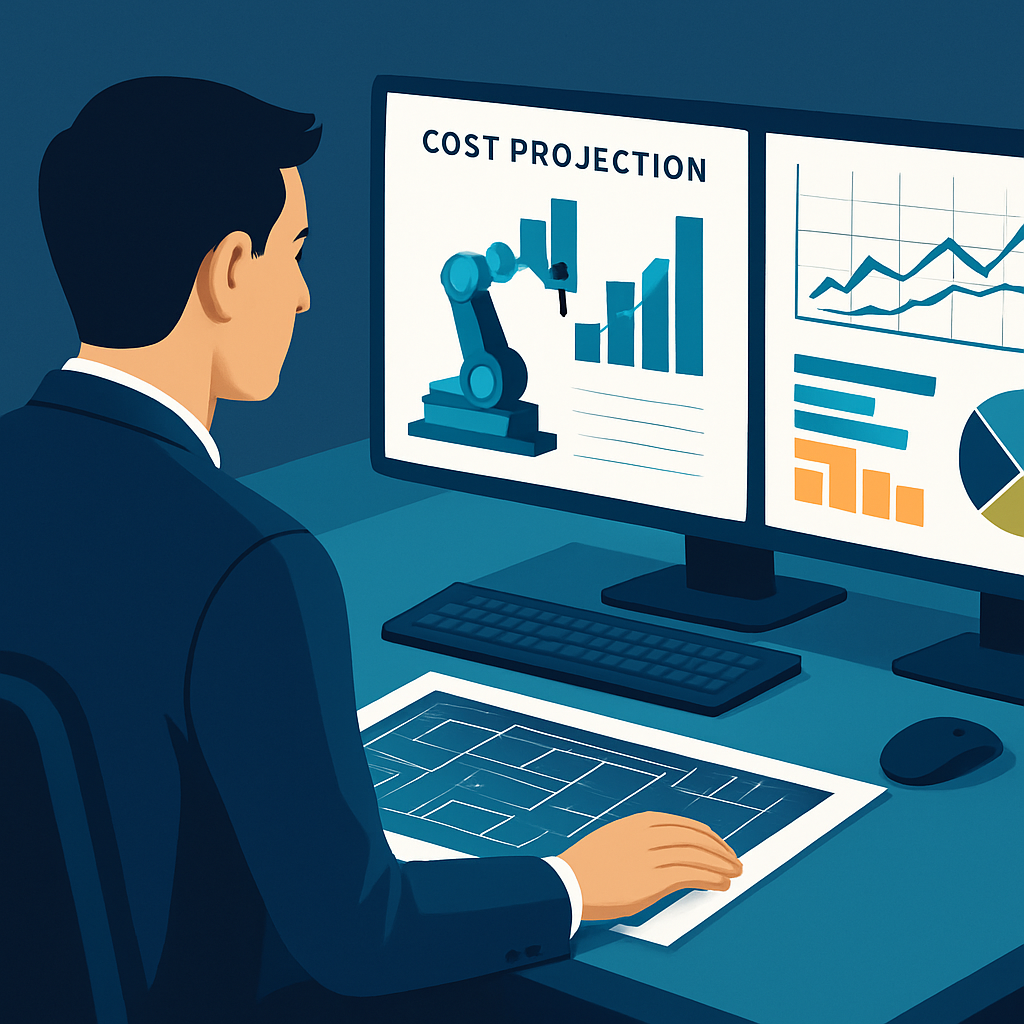 Forecasting automation project costs accurately requires a bottom-up model built from six discrete inputs, not a vendor's ROI multiplier. This post walks through the deterministic economics framework so buyers can pressure-test any proposal before committing budget.
Why Most Automation Estimates Fall Apart
To forecast automation project costs with any confidence, you need more than a vendor's rule-of-thumb multiplier. Most early-stage estimates fail because they treat automation as a single line item rather than a stack of discrete modality choices, each with its own cost curve. A project that involves a robotic arm, a vision system, custom software, and a controlled document workflow has four different cost structures. Collapsing them into one number before the design is settled is how budget overruns begin.
Deterministic economics is the discipline of building that forecast from the bottom up, input by input, before a single component is purchased or a line of code is written. This post walks through the logic so that anyone taking an automation proposal into a CFO conversation can stress-test the numbers.
What Deterministic Economics Actually Means
The word "deterministic" here has a specific meaning. Rather than saying "AI projects typically deliver a 3x return," a deterministic model assigns a concrete cost or savings figure to each decision point in the process design. If the choice is between a fixed-mount camera and a collaborative robot with an integrated vision system, those two options carry different capital costs, different maintenance schedules, and different labor displacement profiles. Each gets its own column.
The result is a model where every assumption is visible and every number traces back to a real input. Change one assumption, such as the shift count or the error rate on the current manual process, and the forecast updates predictably. That traceability is what makes the model credible in a budget review.
The Six Inputs That Drive Any Automation Cost Forecast
Before touching a spreadsheet, collect these six inputs for the process being automated. Missing any one of them forces the model to substitute an assumption, which is where vendor estimates quietly inflate.
1. Current Process Cost
Calculate the fully loaded hourly cost of the labor performing the process today, multiplied by the hours spent. Include supervision, rework time, and any downstream costs from errors. A process that takes three operators four hours per shift at $28 per hour fully loaded runs about $336 per shift before error costs. That number becomes the baseline the automation has to beat.
2. Modality Selection per Step
Map each step in the process to the technology that would handle it. The modalities to weigh are: hardware (conveyors, fixtures, enclosures), robotics, machine vision, machine learning inference, AI orchestration, software integration, and controlled documents such as SOPs and validation records. Not every step needs every modality. A step that is pure data routing probably needs software and a controlled document, not a robot.
For each modality selected, attach a capital cost range and an annual operating cost. Use vendor quotes where available. Use published list prices where quotes are not yet in hand. Do not average across modalities.
3. Integration Complexity
Integration is consistently underpriced. Connecting a new automation cell to an existing ERP, MES, or quality management system requires scoping, middleware, testing, and usually a period of parallel running. A simple API connection between two modern systems might cost $8,000 to $15,000 in engineering time. A legacy PLC talking to a cloud-based AI platform through a custom OPC-UA bridge is a different conversation entirely. Classify integration complexity as low, medium, or high before quoting a number.
4. Validation and Documentation Requirements
In regulated industries, controlled documents are not a soft cost. FDA-regulated facilities, for example, need installation qualification, operational qualification, and performance qualification records for automated systems. Drafting, reviewing, and executing those documents can run $20,000 to $60,000 per system depending on scope. Food, pharma, medical device, and aerospace applications all carry this cost. A cost model that omits it will miss the budget badly.
5. Ongoing Operating Cost
Annual operating cost covers software licenses, maintenance contracts, consumables, calibration, and the labor required to monitor and correct the system. A machine vision system that runs without incident still needs periodic retraining if the product mix changes. An AI inference model that drifts needs a retraining pipeline and someone to oversee it. Budget a minimum of 15 to 20 percent of capital cost annually for a well-supported system, more for systems with high environmental variability.
6. Ramp and Transition Cost
The period between go-live and full productivity is real cost. During ramp, output may be lower, reject rates may be higher, and engineers may need to be on-site. For a straightforward pick-and-place cell, ramp might be two weeks. For a multi-modal system integrating vision, robotics, and AI, plan for 60 to 90 days of reduced throughput and include that in the model as foregone revenue or continued labor cost.
How to Build the Forecast: A Practical Structure
Organize the model in four columns: modality, one-time cost, annual operating cost, and annual savings or revenue impact. Build one row per modality per process step.
Sum the one-time costs to get total capital expenditure. Sum the annual operating costs to get the ongoing run rate. Calculate annual savings by comparing the new operating cost plus the annualized capital (using a payback period the CFO specifies, typically two to five years) against the current process cost calculated in input one.
The result is a simple payback period and an annual net benefit figure. Both should survive a 20 percent increase in cost assumptions. If the project still makes sense when every cost line goes up by a fifth, the economics are solid. If it breaks, the margin is too thin and the design needs revisiting.
Pressure-Testing a Vendor Quote
When a vendor presents a proposal, map their line items to this structure. Ask these specific questions:
- What is the capital cost per modality, broken out separately?
- What integration complexity tier are they assuming, and what is the basis for that assumption?
- Does the quote include controlled document development and execution?
- What is the annual operating cost in year two and year three, after any introductory support period ends?
- What is the assumed ramp period, and what productivity level do they guarantee at go-live versus full production?
A vendor who cannot answer these questions with specific numbers is working from the same rule-of-thumb model that produces overruns. A vendor who answers them clearly, and whose numbers survive a 20 percent stress test, is worth continuing the conversation with.
Where Intellimate AI's Approach Fits This Framework
Intellimate AI operates as what it calls the Know layer: the stage before build, where every modality option for each process step is weighed against deterministic economics. Rather than recommending a technology stack and then pricing it, the process starts with the cost model and works backward to the design. That means capital and operating costs are calculated before any vendor is selected, so the selection criteria include real economics rather than feature lists.
This is useful for both operating businesses planning internal automation and agencies building automation solutions for clients. The framework is the same in either case: inputs first, modality selection second, cost model third, vendor selection fourth.
Taking the Model Into a Budget Conversation
A one-page summary of the model, with the six inputs stated explicitly and the stress test results shown, gives a CFO what they need to approve a project. It demonstrates that the team understands what drives cost, not just what the system will do. It also establishes a clear basis for holding a vendor accountable if costs exceed the forecast.
Mid-year planning cycles tend to favor proposals that arrive with a complete cost model over those that arrive with a capability pitch. The model is the credibility. Build it before the meeting, not after the approval.
Reach out to Intellimate AI to run a deterministic cost model on your specific process before committing to a design or a vendor.
Tags