
Computer Vision in Manufacturing: How to Evaluate It as One Option Among Many
October 14, 2026
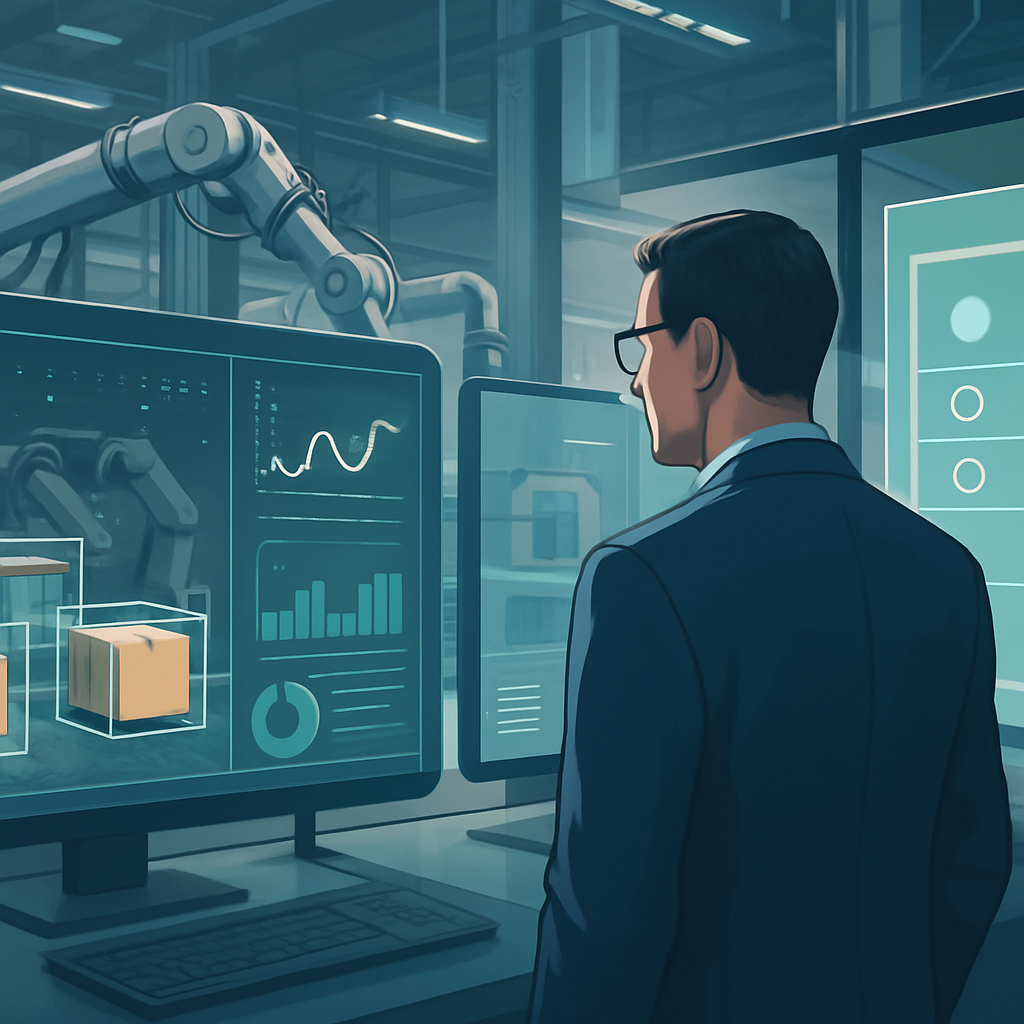 Computer vision is one inspection modality, not a default answer. This guide gives manufacturing teams a step-by-step framework for evaluating whether vision actually solves their specific detection problem, and when a simpler alternative is the better choice.
What Computer Vision Can and Cannot Do on a Factory Floor
Computer vision manufacturing evaluation is not a technical exercise, it is a business decision about whether a camera-based system will actually solve a specific problem better than the alternatives. Many manufacturers are adopting vision technology right now, and some of those projects are failing to deliver. The reason is usually the same: vision was selected before the problem was fully defined, not because it was the right fit.
This guide walks through how to assess whether computer vision belongs in a given process step, what it competes against, and how to structure a decision that holds up when the CFO asks why you spent six figures on cameras.
The Core Question in Any Computer Vision Manufacturing Evaluation
Before looking at vendor demos or proof-of-concept proposals, one question needs an honest answer: what is the defect, event, or condition that needs to be detected, and how is it being missed today?
That question sounds obvious, but the answer is often "human inspectors are inconsistent", which is a management and process problem as much as a perception problem. Vision can replace a human eye, but if the root cause of escapes is inadequate lighting, ambiguous acceptance criteria, or an undertrained workforce, a camera will inherit those same problems unless the underlying conditions are fixed first.
A useful framing is to separate the signal from the system. The signal is what you need to detect: a surface scratch, a missing fastener, a label in the wrong position, a part moving out of tolerance. The system is everything built around detecting it. Vision is one way to detect a signal. Structured light, contact gauging, weight sensors, RFID, and controlled documents with human checkpoints are others. None of those is automatically better. Each has a cost, a detection capability, and a failure mode.
What Vision Does Well
Computer vision is genuinely strong in a narrow set of conditions.
- The defect or event is visible, it has a surface expression that a camera can capture at the required resolution.
- The inspection environment can be controlled well enough that lighting, background, and part presentation are consistent from cycle to cycle.
- The volume of parts is high enough that manual inspection is either too slow or too expensive to sustain.
- The acceptable variance in the "good" class is well understood and can be represented in training data.
- False positives and false negatives both have defined, tolerable costs, and you know which direction is more dangerous.
When all five of those conditions hold, vision is often the right call. When two or three are uncertain, the evaluation is still open. When most of them are absent, vision is probably the wrong tool.
Where Vision Projects Run Into Trouble
The most common failure mode is deploying vision on a problem where the "bad" class is underrepresented. A model trained on 200 images of good parts and 12 examples of defects will not generalize. When the novel defect arrives, and it will, the system either passes it or floods the line with false rejects. Neither outcome is acceptable in a production environment.
A second failure mode is environment variability. Vision systems are sensitive to changes in ambient light, part orientation, surface finish variation between suppliers, and accumulation of dust or oil on lenses. A system that works in January after commissioning may degrade by June without anyone noticing, because the failure is gradual and the operators have learned to override the alarms.
Third is integration cost. A standalone camera with a laptop running inference is not a production system. A production system needs a reliable trigger, a network connection or edge device, integration with the line PLC or MES, a rejection mechanism, logging, and a process for reviewing borderline detections and retraining the model. That infrastructure is often more expensive than the model itself.
How to Structure the Evaluation
Step 1: Define the detection problem with precision
Write down exactly what needs to be detected, at what rate, with what consequence for a miss or a false alarm. "Detect surface scratches on aluminum housings" is not precise enough. "Detect scratches longer than 3mm on the A-surface of part number 4471, at a line rate of 12 parts per minute, with a false reject rate below 2% and zero tolerance for misses on cosmetic-critical units" is a specification you can evaluate against.
Step 2: Inventory the competing modalities
For each process step, list every method that could detect the condition in question. Include mechanical gauging, go/no-go fixtures, coordinate measuring, weight or force sensing, RFID or barcode verification, and human inspection with a structured checklist. Each modality has a cost range, a detection accuracy profile, and a maintenance burden. Vision goes on that list alongside the others, not above them.
Step 3: Run deterministic economics on each option
This means calculating the cost of each option across a realistic operating horizon: capital, installation, integration, training data collection, ongoing maintenance, retraining cycles, and the expected cost of escapes if the system underperforms. A vision system with a 1.5% miss rate on a $40 warranty claim is a different economic proposition than the same miss rate on a $4,000 field repair.
Do not accept a payback period from a vendor without building your own model. The vendor's model will not include your integration costs or your retraining labor.
Step 4: Assess your environment honestly
Before committing to vision, document the inspection environment as it actually operates, not as it should operate. Measure light variation across shifts. Check whether parts arrive with consistent orientation. Find out how often the "bad" condition appears and whether you have documented examples. If the environment is not ready, the first cost is fixturing and lighting, not cameras.
Step 5: Pilot on production conditions, not ideal conditions
A pilot in a controlled lab environment proves very little. A pilot at the line speed, with real parts, real lighting, real operators, and real edge cases proves whether the system is viable. Define success criteria before the pilot begins so the results are not interpreted post-hoc in the vendor's favor.
When a Different Modality Is the Better Answer
There are process steps where a simple physical fixture or a calibrated scale outperforms a vision system on every dimension: cost, reliability, maintenance, and detection accuracy. A go/no-go gauge for a hole diameter does not require training data, does not degrade with light changes, and costs a fraction of the equivalent vision setup. If the problem can be solved mechanically, solve it mechanically.
Similarly, some tracking and verification problems are better handled with RFID or barcode systems than with vision-based OCR. If the part already carries a machine-readable identifier, reading that identifier is more reliable than inferring it from a camera image of a label.
Vision earns its place when the problem genuinely requires seeing a surface or a spatial relationship that no other sensor can capture as reliably. That is a narrower category than the current market would suggest.
Fitting Vision Into a Broader Process Engineering Decision
The approach Intellimate AI takes treats each process step as an independent question: what modality produces the required outcome at the lowest total cost with the required reliability? Vision is one answer among many, and the decision should be made with the same rigor applied to any capital investment.
That means starting with the problem definition, working through the available modalities, building the economics, and only then selecting the technology. It also means designing for the failure modes: what happens when the model needs retraining, when the camera lens is dirty, when a new defect type appears that was not in the original training set?
A vision system that is well-scoped, properly integrated, and maintained with a clear retraining protocol can deliver consistent inspection performance at scale. One that was selected because vision was the answer in another plant's case study will often disappoint.
Start by writing a precise detection specification for the problem you are trying to solve, then evaluate computer vision against the full list of alternatives before any vendor conversations begin.
Tags